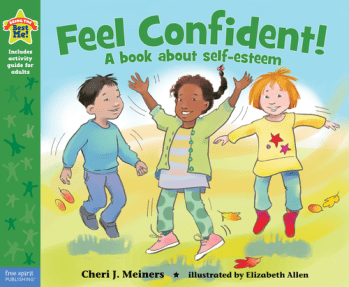
 Feel Confident! (Being the Best Me Series)
By Cheri J Meiners, M. Ed, Illustrations by Elizabeth Allen
Free Spirit Publishing, 2013
Review by Debra Louise Scott
Feel Confident! is one of a new four-book series from Free Spirit Publishing called “Being the Best Me”. The other books in the series are: Be Positive! , Have Courage! , and Bounce Back! Feel Confident! encourages the child to understand how important they are, and how their belief in themselves affects others.
Feel Confident! starts out with “I like being me- a very important person!” This sets the tone for the rest of the book, helping children have confidence in who they are, all by themselves. The book quickly goes on to include trust in those around them who care for them. “They know me best and care for me.”
This book shows that every day there are things we do a little better than we did before, “Each day I grow and get stronger. I love all that my body can do!” This is paired with a list of words that we may take for granted instead of appreciating how they make us unique and strong: touch, sing, run, walk, dance, jump, breathe, hear, smell, and see. The next page has another word list for specific thoughts that affect the child’s confidence: do my best, believe, learn, trust, imagine, be brave, dare, keep trying, I can do it!
The book also encourages children to try something new, and have confidence that maybe they will like it and even be good at it. It also encourages them to make good choices that include the needs of others and to think about when they can do something for themselves or need to ask for help. Surprisingly, it also includes body language which is often overlooked in children’s books, “I show that I believe in myself when I stand up straight, look people in the eye, and smile.”
The author returns to the main themes of the book at the end with well worded reinforcement, “I am important and I’m able to do important things. I can believe in myself and all that I have to give. I feel confident that I can be the person I want to be- because in many ways I already am.”
The downside to this book is that it is for ‘normal’ children. A child with a disability may find it more difficult to identify in some parts. A child that cannot run, cannot breathe well or that must take extraordinary precautions each day (as in those severely allergic to common things) will not feel confident in situations that they have been trained to recognize as dangerous even though their companions run gleefully towards it. They instead experience confusion and a sense of loss. The word list that surrounds a child happily running especially seems challenging (touch, sing, run, walk, dance, jump, breathe, hear, smell, see). How will a deaf or blind child hear or see? Even one page acknowledging this difference would make the whole book make more sense.
Nevertheless, it is a good book for the subject and the age level. It is clear and well written, with real life situations that most children encounter all the time. Most of the vocabulary is suitable for young readers to sound out by themselves and the illustrations are expressive and simple so that it is easy to see how each character feels about what is happening.
After the story, there is a teacher/parent guide to the book with tips on how to discuss and reinforce the issues presented. There is a list of keywords and additional questions separated nicely by page grouping for a more in depth discussion and then several games that can be incorporated into the lesson.

